

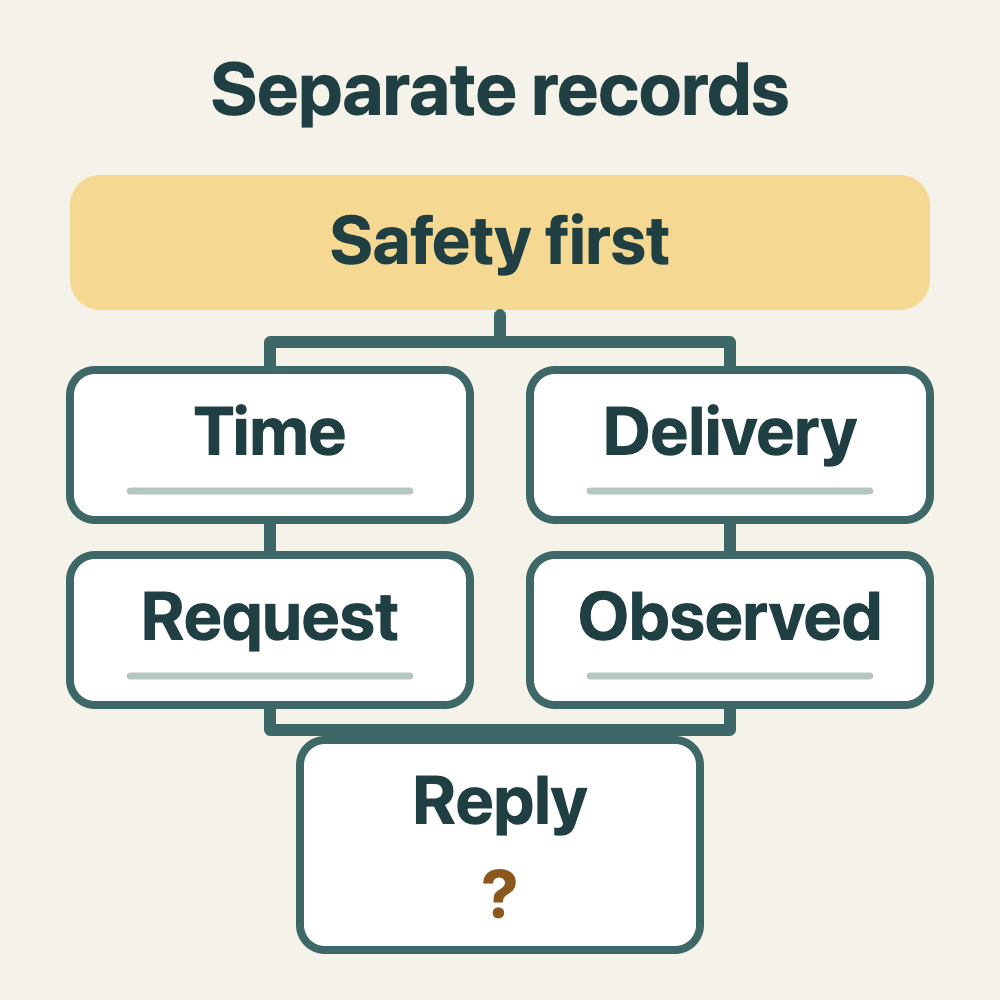
If a food or goods delivery message suddenly asks you to “take a child to school as well,” record it as an additional request that has not been verified. Accepting the order, seeing extra payment or being urged to hurry does not confirm the transport arrangements. Keep the original delivery, the additional request and any help actually obtained separate.
In Taiwan, call 110 for immediate danger to personal safety. Suspected child abuse or neglect can be discussed or reported through the free, 24-hour 113 hotline; see the Ministry of Health and Welfare guidance. Do not delay seeking help to finish this record or await platform support. Describe the location and situation you know; say when something is unknown.
You can keep five fields: the time and channel of the request, what the original order is delivering, the exact transport request, what you actually observe, and the contacts approached with their actual replies. Record a read receipt or sent screen as the status actually displayed, not as a reply received. Record a call not connected, unable to find support and no reply as distinct situations.
Separate “the sender says they are a parent” and “a school is named” from “the guardianship relationship has been confirmed.” A message, photograph, verbal permission or extra payment does not fill gaps in service scope, identity, responsibility or safety. Do not request identity-document photographs of a child or parent to certify the arrangement yourself.
Record only what you actually observe about whether a child is present, whether anyone is looking after them and whether there is immediate danger. Not seeing a caregiver does not establish abandonment. One message does not establish the family’s circumstances. Leave what you cannot determine open and explain it to an appropriate contact.
Use a support entrance actually visible for this order to ask, for example: “The original delivery is __. At __ I received a request to transport a child. The situation I can observe is __. Please confirm how the original delivery should be handled and which official contact should handle the additional request.” This is a question to fill in, not a reply already given by a platform.
No reply does not mean permission to transport the child has been obtained. A platform reply about one delivery issue does not automatically settle guardianship, transport-service or on-site safety questions. Record who replied, when and their wording, then check each issue. Do not agree to transport someone first, or assume cancellation, waiting pay, compensation or exemption from responsibility is guaranteed.
If the child is already present, do not take them elsewhere or hand them to an unverified person merely to complete the delivery. If safety is in doubt, consider your own and the child’s immediate safety, explain the situation to an official assistance service and follow its instructions. Do not investigate family relationships yourself, argue with the sender or identify people publicly.
Keep the original delivery and child-safety assistance as two records. An order marked complete does not establish that the transport request has been safely addressed. Reaching an assistance service does not cancel or settle the original delivery. Save the last order status actually observed, the instructions received and the replies still missing; do not backfill “resolved.”
Public comments and group chats do not need the child’s name, photograph, class, full address, access code or an entire account screenshot. Give a verified official or platform contact the information needed to handle the situation, and retain your original messages. Do not send sensitive information to an unfamiliar private-message account in return for a promise of help.
For a food delivery to a school, use the separate school-entry, stopping and handover checklist for entrances, stopping and receipt by another person. Keep the delivery status, the additional request and help actually obtained separate, so your next question can identify what is confirmed and what still needs attention.