
Outbound Group

How to Make Yourself Visible While Delivering on Night Shifts: Lighting, Reflectivity, and Safe Parking—A Delivery Checklist

Last Updated: July 16, 2026 | For platform rules, bonuses, and real-time information, please refer to the official app or announcements.

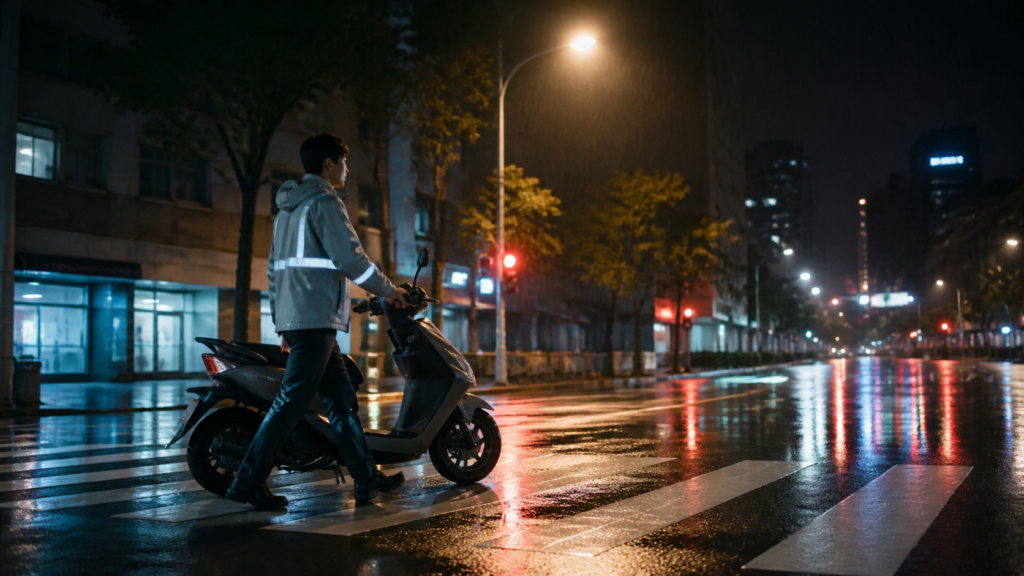
After driving the night shift for a while, it’s easy to fall into a false sense of security: the roads seem less crowded, the orders come in smoothly, and it feels like it should be easier than driving during rush hour. The real trouble isn’t usually heavy traffic—it’s poor visibility. People suddenly opening doors at alleyways, store numbers obscured by signs, unlit entrances to neighborhoods specified by customers, and those few dozen seconds spent looking down at the app while on the side of the road—these are all risks that delivery riders face particularly often. My habit isn’t to wait until I feel the lighting is insufficient to take action; instead, I treat my night-time gear and parking methods as part of my standard pre-shift checklist. Avoiding even one sudden stop or having to search for a door in the dark usually pays off more than rushing to take one extra order.

Let’s be clear: this isn’t about making your vehicle’s lights as bright as possible. The Ministry of Transportation’s guidelines on motorcycle lighting remind riders that low beams should be used when meeting oncoming traffic at night or when there is a vehicle within 100 meters ahead. Arbitrarily changing the light color, installing flashing devices, or covering reflective markers may affect other road users and compromise traffic safety. For delivery riders, stock, standard, and visible lighting is far more important than dazzling or flashy lights. You’re carrying an insulated cooler and frequently navigating alleys and residential neighborhoods, which already creates more blind spots than a typical commute; ensuring your rear visibility is clear is about letting the vehicle behind you know where you are sooner—not about looking good in photos.

One minute before you start work, check to see if others can see you.

I’ll start by standing behind the car to check the taillights, brake lights, and turn signals, then move to the front to verify that the low beams are working properly. It’s best not to just sit in the car and check the dashboard, because a light coming on there doesn’t necessarily mean the rear lights are actually working. According to the Ministry of Transportation’s vehicle inspection guidelines, lights, tires, and brakes are listed as items that directly affect driving safety and should be checked daily. If your taillights flicker on and off or your brake lights are noticeably dim, you shouldn’t push through a long shift tonight. These kinds of minor malfunctions may not be noticeable during the day, but on rainy days or in unlit alleys, even a one-second delay in a following vehicle spotting you can make all the difference in terms of risk.

You don’t necessarily have to buy a bunch of new gear to improve your visibility. I’d start by checking the back of my cooler, the back of my rain jacket, and the back of my helmet to see if they’re covered by stains, stickers, or loose accessories. When adding reflective elements, choose options that won’t block your license plate or lights or interfere with your ability to turn your head; A reflective vest that’s easy to put on and take off is often more practical than covering your bike with light strips. The point isn’t to turn yourself into a light source on the road, but to give drivers approaching from the side or rear enough time to recognize your outline and movements before you slow down, pull over, or prepare to turn.

Cell phones can also affect nighttime safety. If the navigation screen is too dim, it’s hard to see; if it’s too bright, your eyes will momentarily struggle to adjust to the darkness after looking away from the screen. I usually check the next turn while waiting at a red light or when safely stopped, rather than zooming in on the map while riding near an intersection; You should also make sure that order notification sounds, charging cables, and phone mounts don’t block your instrument panel or cause your phone to wobble constantly. If your phone, internet connection, or power supply is already unstable, troubleshoot these issues before heading out—don’t let a connection drop while navigating at night turn into a double risk.

On rainy days or right after it has rained, I make a point of checking my visor and rearview mirrors again. A fogged-up helmet visor (both inside and out), the brim of a rain jacket blocking your peripheral vision, or a rearview mirror covered in water droplets can all make you think you’ve checked everything, when in fact you’ve missed a car approaching. Carrying a small, clean cloth is more reliable than waiting until you reach an intersection to wipe the visor with your glove; if the visor keeps fogging up, first adjust ventilation or pull over to a safe spot to take a break. This isn’t about pursuing perfect visibility, but about avoiding the need to guess—when you most need to judge distances—whether what’s ahead is a pothole, a glare, or a moving vehicle.

Arriving at the store, making a delivery, or waiting for a customer: I’d rather walk a few extra steps than take my chances on that short stretch of the roadside.

The thing that most often leads to carelessness at night is thinking, “I’ll just stop for a second.” When picking up an order, I first look for a legal spot where the car behind me can see me coming, and only then do I check the app and open the insulated box; don’t just park at a corner, in front of a crosswalk, at the exit of an alley, or next to a bus stop just because there happens to be an empty spot right in front of the store. If the entrance to a residential complex is dimly lit, park your bike in a well-lit spot that won’t obstruct traffic first, then walk in to confirm the house number. This is much safer than riding into a dead-end alley while searching for the address and being honked at by the car behind you. If you really need to pull over, signal first, check your rearview mirror, and then slow down smoothly; these are basic steps, but they’re the ones most easily skipped when you’re in a hurry during the late-night shift.

If a customer requests to “park at the management office,” “go to the basement,” or “go straight upstairs,” first check the on-site rules and whether it’s safe to park there. Avoid forcing your way through unclear ramps, basement exits, or in front of restricted barriers just to secure an order. If you have questions about the address or delivery method, contact the customer from a safe location first—do not park in the middle of the driveway to send a message. This isn’t about slowing down efficiency; it’s about breaking down potential issues—such as minor collisions, disputes over late deliveries, or spilled food—into manageable steps. If anything unusual occurs during delivery, be sure to note the time and take a screenshot; document the facts first, then address any follow-up explanations.

If you frequently work in a particular commercial district, I highly recommend keeping your own “evening shift parking notes.” It doesn’t have to be complicated—just note which side of the street is better for temporary parking, which entrances close at night, and which sections of the street often have delivery riders lining up. This will save you from having to drive around in circles on the spot. This isn’t about treating public roads as private parking spaces; it’s about knowing before accepting a delivery whether it will require a few extra steps, whether you should check the pickup location first, or whether it’s better to simply wait for the next, more suitable order. After delivering for a while, you’ll find that what really saves time isn’t stepping on the gas, but avoiding dangerous U-turns and illegal parking.

Even during the last shift of the evening, I never skip my checks just because I’m about to finish work. The weight of the meals, the fasteners on the insulated box, and reduced visibility from a wet raincoat can all make a bike that’s normally familiar difficult to control. If, before arriving at a store, you notice the brakes feeling spongy, your headlights suddenly dimming, or increased tire slippage, first safely complete the current ride or report the issue to the platform. Then stop accepting new rides and head to a repair shop—don’t take a chance by thinking, “I’ll just make it through one more trip.” At the station,Tips for Daily Maintenance of Food Delivery MotorcyclesThere’s a daily routine for maintaining supplies and tires; nighttime problems usually don’t happen suddenly—they’re often minor warning signs that were already present during the day but are magnified in the dark.

I think the most practical measure of a night shift isn’t “how many hours I worked today,” but whether, at the end of each shift, the lights, brakes, tires, and I all make it home safely. This article focuses on how to make yourself visible after dark and how to leave yourself an escape route before pulling over; for other safety tips and everyday experiences related to delivery rides, check outFood Delivery HubFurther Reading: If your lighting system is malfunctioning or you have concerns about modifications, please have it inspected by a certified auto repair shop first. Do not resort to temporary fixes like taping lights in place or cutting and splicing wires to keep them running.

I also set a personal rule for myself: “If I feel uncomfortable, I call it a day.” What I fear most at night isn’t just the lack of visibility, but also overestimating distances due to eye strain: a gap that seems wide enough might actually be too narrow; a speed I think I can stop from might not be safe on a wet road. When I have several consecutive runs that involve navigating alleys, searching for house numbers, or dealing with the pressure of oncoming traffic, I’d rather stop at the next safe spot to drink some water and organize my gear before deciding whether to continue working. Taking this break doesn’t mean you’ll earn less; it means you won’t end up trading all the income you’ve earned so far today for repair costs, medical bills, or an accident with unclear circumstances.

Your pre-ride check doesn’t have to be a lengthy ritual: just make sure the lights are on, the brakes are working properly, the reflectors aren’t covered, and your phone is securely mounted—checking these four things is enough. What really matters is doing this every day, so that even when you’re tired or in a hurry, you have a set routine that doesn’t require you to guess on the spot. When your night shift ends, don’t let your habit of getting home safely fade away; since you’ll be back on the road tomorrow, address today’s risks by checking them off your list. This is one of the most easily overlooked yet most worthwhile fundamental skills in delivery work—one that pays off over the long term and best protects your income.

This article is based on motorcycle safety data from the Ministry of Transportation and delivery scenarios; it does not replace traffic laws, vehicle inspection regulations, or the platform’s current policies. For information on nighttime lighting requirements and modification restrictions, please refer to168 Traffic Safety Portal; For information on the importance of checking your lights, brakes, and tires daily, seeHighway Bureau Supervision Information. Please refer to on-site conditions and official announcements for actual road conditions and platform rules.

Scroll to Top

🔍 Food Delivery Encyclopedia AI Assistant

👋 Hi! I'm your AI assistant. Feel free to ask me any questions about food delivery!