

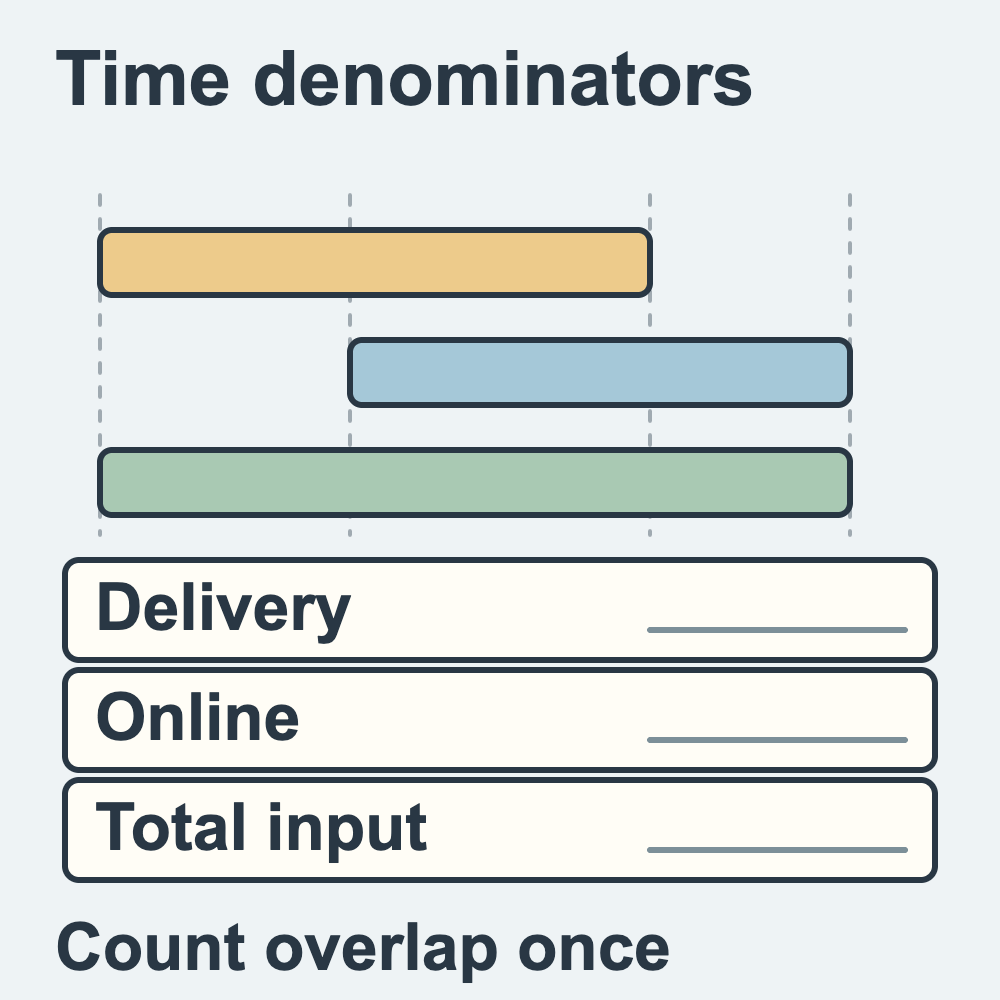
Records organised on 23 October 2026. Dividing the same delivery income by “time spent delivering” or by “the whole period committed” produces different numbers. State the denominator first so you know what you are comparing. This article provides a time example you can recalculate, not a test of ten riders, an earnings ceiling or a guarantee of future platform income. This personal ledger cannot replace the service period used to check statutory basic remuneration either.
First retain the actual timeline for the same period: when you prepared for delivery work, opened order availability, waited or delivered, took a break or dealt with personal matters, and ended the relevant arrangements. Records should lead back to original time points. Do not invent a task for every minute or assume that an app being online means orders were being completed throughout.
You can show three denominators side by side, retaining each name with its value:
| Time basis | How this ledger records it | What the result does not establish |
|---|---|---|
| Delivery intervals | State your chosen start and end points, such as accepting an order to completing it. Retain the endpoints of overlapping intervals. | It is not the net hourly earnings of all riders and does not independently determine a statutory service period. |
| Online intervals | Record actual start and end times for order availability, separating waiting, deliveries and unexplained interruptions. Count overlapping clock time across apps only once. | Being online does not guarantee orders. You cannot simply add all the durations displayed by different apps. |
| Total committed intervals | Specify preparation, necessary travel or reconciliation time additionally included in this personal comparison. List personal journeys and breaks separately rather than automatically attributing them to delivery work. | Your chosen scope is not statutory paid working time, and unknown time must not become 0. |
Consider an arrangement that is entirely fictional and only for arithmetic teaching: preparation from 10:00–10:15, order availability from 10:15–11:45, and organising these delivery records from 11:45–12:00. Within the online interval, one delivery runs from 10:30–11:00 and another from 10:50–11:20. For a comparison of your actual clock time, the union of delivery intervals is 10:30–11:20, or 50 minutes. Adding two 30-minute deliveries produces 60 minutes and counts the ten minutes from 10:50–11:00 twice. This organises personal time within the same period; it does not rewrite per-order platform remuneration checks.
Continuing this fictional example, assume that reconciled income R for the same period is NT$300, excluding money of a different nature such as cash collected for remittance or refunds. Costs C confirmed for this comparison, without duplicate deductions, are NT$60. R−C = NT$240 is a comparison surplus after only the costs listed in this example, not complete after-tax income. Identify other missing costs or amounts separately. If a gap affects the comparison, stop calculating rather than fill it with 0. All amounts here are New Taiwan dollars (TWD).
- Using the 50-minute union of delivery intervals: 240 ÷ (50 ÷ 60) = NT$288 per hour.
- Using 90 minutes online: 240 ÷ (90 ÷ 60) = NT$160 per hour.
- If this comparison explicitly includes the 15 minutes before and after, total committed time is 120 minutes: 240 ÷ (120 ÷ 60) = NT$120 per hour.
All three results come from the same assumed data. None on its own can be called “a rider's fixed hourly earnings”. The difference is scope, not three separate incomes. With your own data, replace R, C and each interval's endpoints with traceable records. If income already includes tips or adjustments, or has fees deducted, do not add or subtract the same items again. Without complete costs, label the result “after listed costs only”, not net profit or after-tax income.
Keep this line for the next comparison: “Comparison period __; income R scope and evidence __; cost C scope and evidence __; delivery / online / total committed time __ minutes, with intervals __; how overlaps were excluded __; missing data __; calculate now / hold __.” Retain these conditions when changing city, platform, vehicle type or time of day. Do not attribute every difference to dispatch algorithms or one promotion.
Keep the boundaries on the sheet as well: when time is zero or cannot be confirmed, do not divide. If income minus listed costs is negative, retain the negative result and its explanation rather than clamp it to 0. If breaks, personal journeys and work cannot be separated, mark them inseparable instead of inventing minutes. This article sets no number of days or orders after which a result is necessarily reliable, and does not extrapolate one peak interval into annual income.
For monthly and annual views, use the ledger for annual record coverage and attribution across months. Retain each month's denominator and gaps before deciding whether comparison is possible. The example here does not rank platforms or certify your personal accounts. Find other income-recording situations in the delivery-experience category. Making the time scope understandable is more useful than reporting just one “per hour” number.