

Information checked: 23 October 2026. The earlier article's September traffic-safety campaign, prize-draw dates and crash statistics are not a basis for entering an activity or accepting an order now. This revision keeps the question of preparing before an intersection, removes unverified first-person practices and the income claim that slowing, looking and stopping must pay better. If an address or the next turn is unclear, first find a suitable place to stop safely; do not look down to check navigation while riding.
The Taiwan Road Traffic Safety Portal's 2020 explanation of distraction (Traditional Chinese) lists looking down to operate a phone and check road information while riding as a distraction. Its 2021 article on red lights and phones (Traditional Chinese), republishing New Taipei City's Transportation Department, also advises finding a suitable place to park and switching off the engine before viewing messages or maps. These are the limited official reminders previously read. They do not establish today's fine amounts, or that a phone mount, voice function or red light guarantees lawful or safe use.
Before setting off, identify the shop entrance, delivery address and next part of the route well enough to recognise them, and secure the bag properly. If a new message arrives or a house number does not match while you are moving, “nearly there” is not a reason to search while riding. Keep your attention before an intersection on signals, pedestrians and traffic. If you need to check something, choose a suitable stopping place first, rather than suddenly stopping at an intersection, in a pedestrian route or in a traffic lane to use the phone.
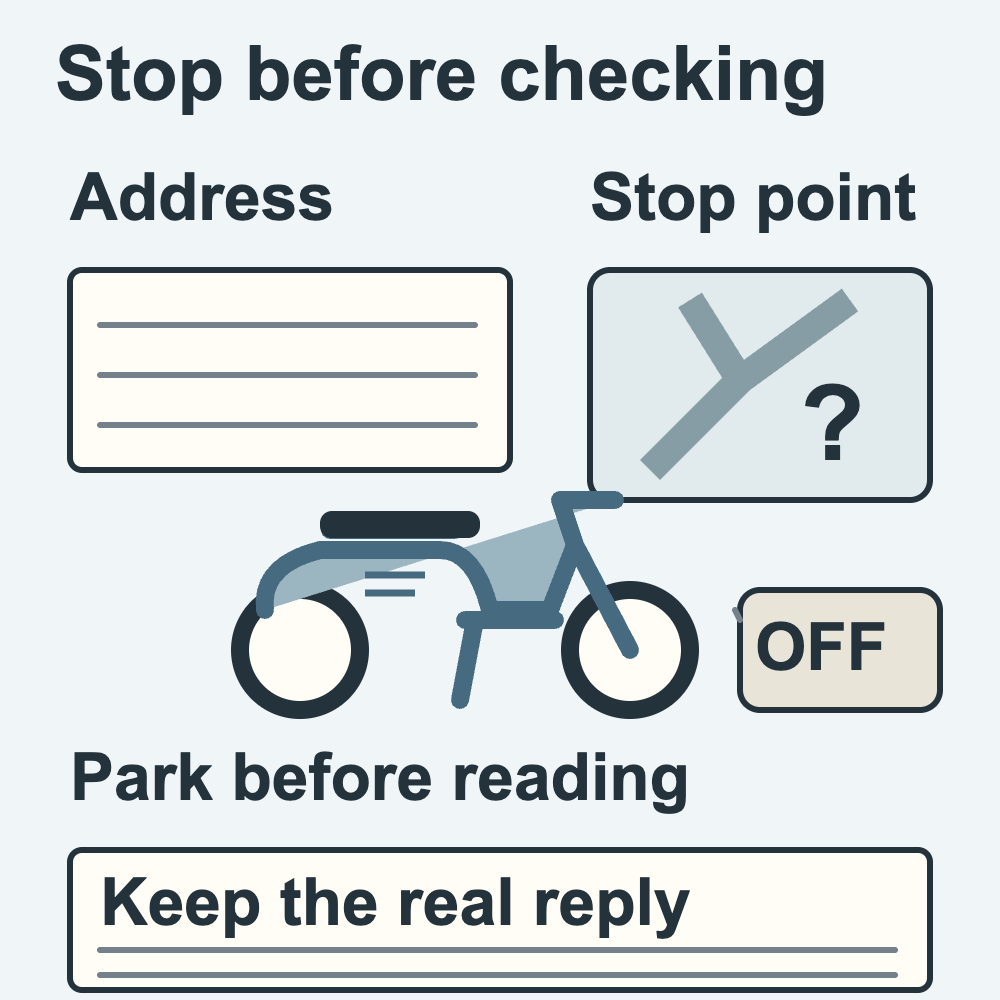
Use this short card for unresolved details before a trip, without recording the customer's full personal information:
- Address gap: shop or building entrance currently identified ____; unclear or conflicting detail ____; which order information and its time ____.
- Stopping arrangement: lawful stopping place you can confirm in advance ____; suitable place to reassess if it is unavailable on arrival ____.
- Check needed: message or map detail to view after parking and switching off the engine ____; question for the platform, shop or receiving contact ____.
- Reply obtained: contact channel ____; time ____; actual reply ____; still unconfirmed ____. Leave it blank if there is no reply; do not record permission as obtained.
- Revised arrangement: reason for rerouting or pausing ____; route or handover location to recheck ____; matters to reassess after the next safe stop ____.
If someone is urging you to hurry, a specific question can help: “I need to confirm the ____ entrance/number and have parked in a suitable place. The order information says ____, while the visible sign says ____. Please confirm which location to use.” This is an editable example, not a real delivery or support reply. An unconfirmed parking suggestion is not lawful permission, and a platform deadline is not permission to stop unlawfully or cross an intersection improperly.
The earlier article used statistics from different road settings and comparisons involving seconds saved and another order's earnings. This version does not use them to estimate your crash probability or income, or retain unconfirmed claims about “my practice”. Its purpose is to move checks earlier: confirm address and route before riding, do not catch up on phone tasks while moving, and stop first when a check is needed. The delivery navigation and parked-check guide covers further preparation, but it also cannot decide whether a particular parking place is lawful.
The card can record where information was missing and where you stopped to reassess, without the customer's full address or phone number. It helps prepare the next trip; it does not guarantee every trip's safety. Use the news category to check the original publication date and scope of dated campaigns. Verify current announcements separately for participation or eligibility; the old September dates in this article do not establish them.