During Traffic Safety Month in September, when delivering food, it’s more worthwhile to slow down, look, and stop at intersections than to rush to get one more order.

September Traffic Safety Month: Delivery Riders Should Slow Down, Look, and Stop at Intersections; Yield to Pedestrians; and Conduct Safety Checks Before Accepting Orders

Last Updated: September 9, 2026
Eligible Participants: foodpanda, Uber Eats, Lalamove, and other delivery riders who use motorcycles to make deliveries.

Traffic Safety Month in September has begun. For food delivery riders, the focus shouldn’t be solely on whether there are any prize draws; rather, it’s about making “Slow Down, Look, and Stop at Intersections” a rule they follow every day before heading out on a delivery. Authorities have recently reminded the public that failing to yield at intersections may result in fines, with even heavier penalties if a pedestrian is struck. The Traffic Safety Portal also notes that from January to May of Year 115, pedestrian fatalities in traffic accidents nationwide reached 132, with accidents at intersections accounting for the highest proportion—nearly half. When applied to the delivery industry, these figures boil down to one simple truth: taking on one extra order doesn’t necessarily mean more profit, but causing one more accident or receiving one more ticket will definitely result in a loss. When you’re out making deliveries today, be sure to factor in your order-acceptance radius, turning speed, drop-off points, following distance in rainy weather, and the blind spots of larger vehicles into your cost calculations.

The biggest difference between delivery riders and regular commuters is that you might pass through the same set of intersections more than a dozen times a day. You’re familiar with the restaurants, the buildings, and which alleyways have police officers—and it’s easy to let your guard down because you know the area so well. The problem is that accidents often don’t happen in completely unfamiliar places, but rather in the very spots where you think you’re an expert at riding, weaving through traffic, and timing your moves perfectly. When a new order pops up on the app, the screen only shows you the distance, restaurant, pay, or estimated time—it doesn’t factor in the risks at those intersections. So it’s up to the delivery rider to account for that.

I’d recommend setting today’s running mode to “Prioritize Intersections” rather than “Prioritize Time.” When encountering uncontrolled intersections, parking lot exits, areas near schools, or sections with high contrast in twilight lighting, first relax your right hand to slow down, then check left and right for people, cars, bicycles, or doors that might suddenly open. Delivery routes are often caught between two pressures: on one hand, platform time limits; on the other, uncontrollable risks at intersections. Platform time limits can be managed through notes, customer service, or reporting unreasonable delays; but once an accident occurs at an intersection, it leads to police reports, insurance claims, medical expenses, vehicle damage, time off work, and a negative platform record—costs that far exceed the earnings from a single delivery.

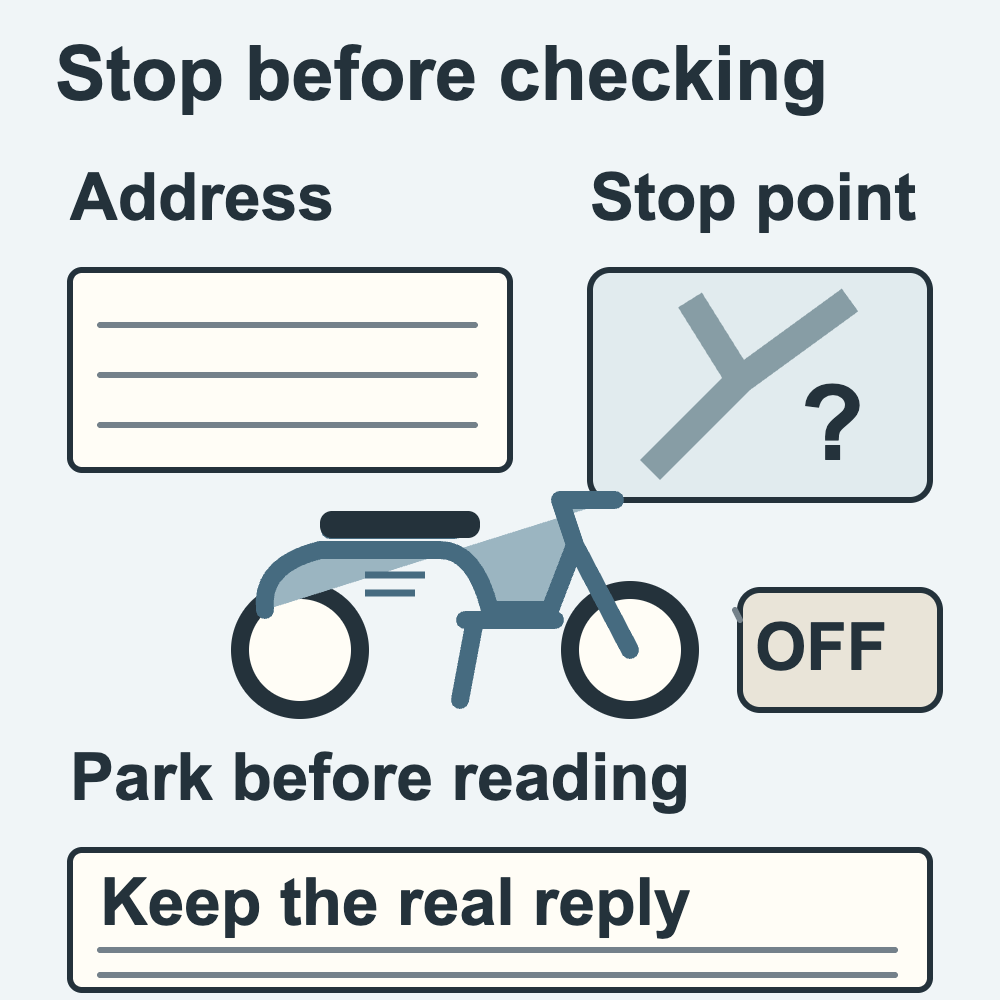
According to information from the Traffic Safety Portal on September 2, when approaching an intersection, drivers should slow down, look, and stop; when turning, they should also pause to confirm it is safe before proceeding. This advice is particularly useful for food delivery riders, as the most common dangerous behaviors in this line of work include entering intersections while looking at a navigation app, rushing into an intersection when they see the restaurant is nearby, and starting to look for house numbers during the final 200 meters before delivery while ignoring traffic. My approach is to check the navigation app only on straight, stable stretches of road and avoid looking down before entering an intersection; if I really need to confirm the address, I pull over to the side of the road before checking. This may sound obvious, but it helps prevent many low-speed collisions, sudden braking and reversing, and customer complaints about delays.

When yielding at intersections, drivers shouldn’t focus solely on pedestrians. Food delivery riders often navigate alleys, commercial districts, night markets, and areas near markets, where they may encounter parked vehicles, taxis, baby strollers, garbage trucks, small cargo vans, and store delivery vehicles. On September 4, the Traffic Safety Portal also highlighted the risks associated with small cargo vans. Data showed that from January to July of Year 115, there were a total of 197 accidents involving small cargo vans on the central section of the expressway, including 36 serious incidents that resulted in 2 deaths and 18 injuries. While food delivery riders rarely use highways as part of their daily routes, the center of gravity, cargo, blind spots, and risk of sudden stops associated with small trucks are just as important to watch out for at alleyways in urban areas. If you see a truck backing up, turning, or pulling over to unload cargo, do not squeeze past it by hugging the side of the vehicle; the 5 seconds you save could result in a difficult-to-resolve liability dispute over a fender-bender.

You can use this handy chart today to decide whether to accept an order—don’t just look at the amount:

Points to Consider Before Accepting an Order A relatively reliable assessment Situations to Avoid
Restaurant Location Parking spots are clearly marked, so there's no need to park against traffic or park illegally in two separate spots. The entrance is on the corner of a major intersection, where trucks are often unloading.
Address for Service The building entrance is clearly marked, and it is safe to pull over next to it. The alleys are narrow, house numbers are hard to find at night, and it’s often necessary to park temporarily on the road.
Route Risks You can take familiar main roads with good visibility at intersections After school, peak market hours, and wet, slippery road markings after rain
Determination of Compensation Even after factoring in distance, wait time, and the risk of stopping, the cost remains reasonable To earn a small reward, he drove long distances and passed through multiple high-risk intersections one after another

Many food delivery drivers treat traffic tickets as incidental costs, but if you break it down into your hourly wage, you’ll find it’s not worth it. Suppose you make just a few dozen yuan extra by taking one extra delivery during the dinner rush hour, but end up with a ticket for failing to yield or illegal parking because you were rushing—that could wipe out your net earnings for the entire night or even the week. What’s even more troublesome is that the cost of an accident isn’t just the fine—it also includes repairs, time off work, insurance claims, damage to phone mounts or insulated boxes, and abnormal order records on the platform. Truly skilled riders don’t try to run every red light; they know exactly where they can’t cut corners.

The “Zero Violations” raffle in September can also serve as a convenient opportunity for self-assessment. According to the Highway Bureau’s event website, the registration period runs from 12:00 p.m. on August 28, 115, through September 30. Early birds who register by September 15 will receive more raffle entries; eligibility will be determined based on traffic violations and accident records during the event period. Delivery riders shouldn’t view this as simply a chance to win prizes; instead, treat September as your personal “traffic record month”: After finishing work each day, review whether you ran a yellow light, parked illegally, failed to signal, followed too closely in the rain, or used your phone while riding. If any of these occur frequently, it means you need to adjust your riding habits.

In practice, I break down today’s delivery routine into three principles. First, check the route after accepting an order—don’t wait until you’ve started the car to change your route on the fly. Second, plan your parking spot before picking up the order—don’t try to squeeze into a street corner once you arrive at the restaurant. Third, slow down during the final 300 meters before delivery, as this is when you’re most likely to be checking your navigation, looking for the house number, answering calls, and replying to messages from customers all at once. It’s not that delivery riders shouldn’t strive for efficiency—it’s just that efficiency should come from knowing your routes well, minimizing wait times for meals, and reducing empty runs, not from racing against the clock at intersections.

If you encounter rainy weather or afternoon thunderstorms, be sure to slow down even more at intersections. Slippery road markings, construction metal plates, manhole covers, and potholes filled with standing water can all increase braking distances for motorcycles. In this kind of weather, avoid taking back-to-back orders that are too close together, and don’t rush to complete them just because the platform’s estimated delivery time is short. Check the Central Weather Bureau’s real-time weather and radar data first, then decide whether to reduce your order radius. On rainy days, the real priority is “consistently completing orders,” not the surface-level number of orders.

FAQ:

Question 1: Do food delivery drivers need to register separately for the Traffic Safety Month campaign?
Not necessarily—participation in the campaign is voluntary; however, if you are eligible, you can visit the Highway Bureau’s campaign website to review the registration requirements. Even if you don’t sign up, we recommend treating September as a “zero-violation” month, as this will directly impact your take-home pay and accident risk.

Question 2: Will slowing down, looking, and stopping at intersections cause me to lose a lot of money?
Usually not. What really slows down earnings are things like waiting for orders, having trouble finding an address, making empty trips on the way back, and picking up orders in the wrong area. Spending a few extra seconds to check at an intersection reduces the risk of tickets, fender-benders, and suspension from work, so it pays off in the long run.

Question 3: The platform's deadline is tight, and the client is pressing for a response. What should I do?
Prioritize safe delivery; do not run red lights to make up for lost time. If you have to wait too long at a restaurant or the address is unclear, keep a record and report the issue according to the platform’s procedures; do not take on unnecessary risks just to make up for someone else’s delay.

Question 4: When a delivery rider sees a small truck or a large vehicle turning, what should they pay the most attention to?
Don’t drive too close to the vehicle, don’t cut it off, and don’t park in the driver’s blind spot. Large vehicles and pickup trucks have blind spots and may move suddenly when turning, backing up, or unloading. It’s better to stop for a moment and wait until they’ve finished their maneuver.

Question 5: Should I still accept long-distance rides as usual on rainy days?
It depends on the pay, the route, and the condition of the vehicle. If a long-distance ride on a rainy day passes through multiple high-risk intersections, bridges, or construction zones, it may not be worth it—even if the pay seems high—due to reduced speed and increased danger.

Question 6: If you could do just one thing today to reduce risk, which would you do first?
Start by making sure you “don’t look down at your navigation app before entering an intersection.” You can check your navigation, messages, or street addresses after pulling over to the side of the road; when approaching an intersection, keep your eyes on pedestrians, vehicles, traffic signals, and the risk of sudden movements.

Related Articles:

Source:

CTA:Before heading out today, I saved a screenshot of the table from this post on my phone; before the dinner rush starts, I’ll check the restaurant pickup locations, delivery intersections, and rainfall—I don’t want a single ticket or fender-bender to wipe out my entire night’s earnings.

Disclaimer: Traffic regulations, eligibility requirements for activities, platform operating hours, and insurance claim conditions are subject to change. Please refer to the latest announcements from the Ministry of Transportation, the Highway Bureau, the Central Weather Bureau, and the respective platforms. This article is intended for general informational purposes only and does not constitute legal, insurance, or financial advice.

Scroll to Top