

Records organised on 23 October 2026. Adding a few busy months and scaling them up to twelve can look like annual income while assuming that unrecorded months performed just as well. This annual ledger helps you identify how much of the year the records cover and which amounts are still unreconciled before deciding what can be added. No one's complete original accounts for 2024 were obtained for this article; it does not supply a real annual earnings figure for a beginner to adopt.
First choose a view of the year and name it in the heading. For example, “actual receipts and payments from 1 January to 31 December” tracks when money was received or paid during that year. “Income and expenses attributable to delivery work in the same period” instead requires each amount to be linked to its work or usage period. In the first view, payment in January does not establish that the money was earned through January's work. In the second, money not yet received must not be marked as received. You may keep both views, but must not add the same money again. This organises your own records; it is not a rule for recognising amounts for tax purposes.
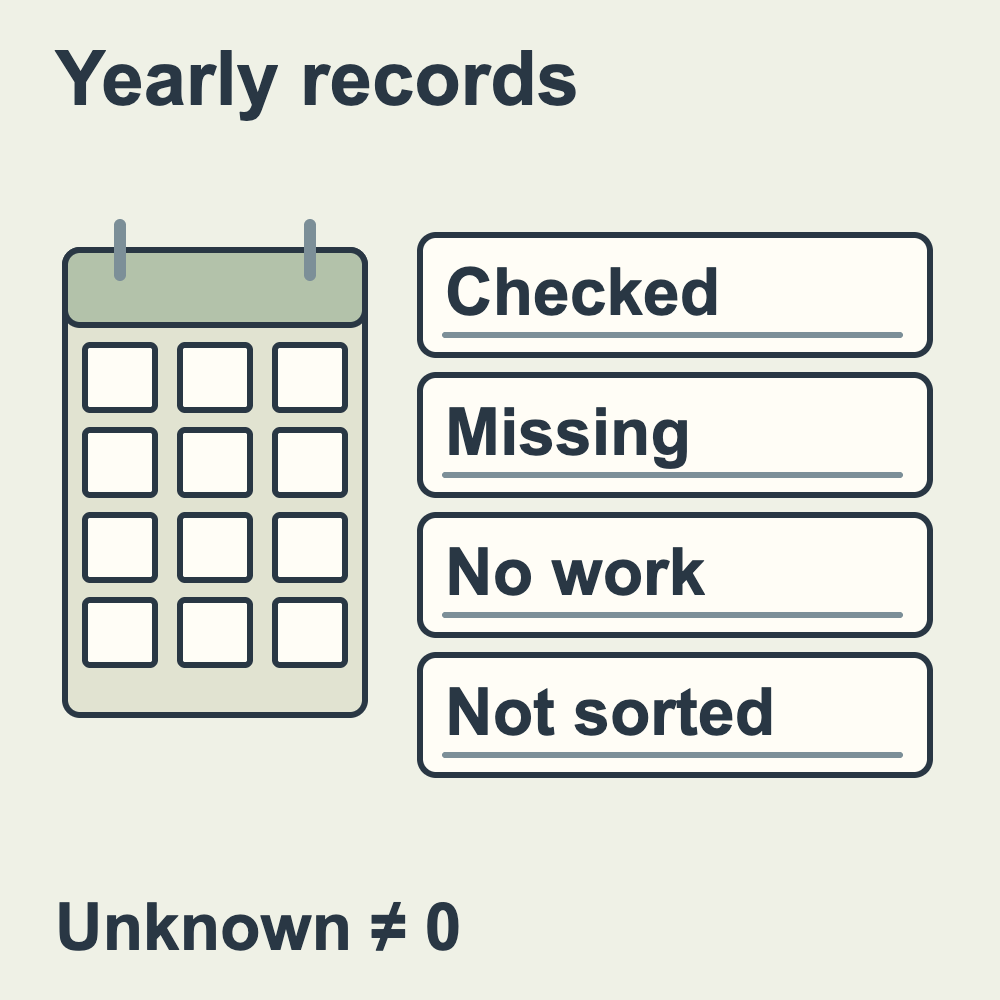
Give each month a data status before entering amounts. This separates “did not work” from “did not record”:
| Status | Explanation to retain | How to show it in the annual ledger |
|---|---|---|
| Reconciled to the chosen basis | The month, platforms or accounts covered, and the statements, receipts, payments or cost documents checked. | Include only reconciled values belonging to that basis, retaining a reference to their sources. |
| Worked, but records are incomplete | Which accounts, dates, amounts or costs are missing, and what can currently be confirmed. | Show the known subtotal and the gaps. Do not present a complete month or fill missing items with 0. |
| Confirmed no delivery work | Which period and accounts were checked, and whether earlier work was still being paid or ongoing expenses remained. | Record work time as 0 only where the records confirm it. Check that month's receipts and payments individually; do not automatically set them all to 0. |
| Not yet organised or cannot be confirmed | Which month's records have not been obtained, or which period cannot yet be identified. | Keep it unconfirmed. Do not carry over the previous month's average or treat it as known zero income. |
Next make a working sheet with one row per month. Copy this line twelve times: “Month __; data status __; reconciled income and scope __; reconciled expenses and scope __; not yet received or awaiting adjustment __; missing documents __; actual time committed this month __; city, platform or work arrangements different from last month __; original-document reference __.” Write the scope before the value, so that a platform statement total is not followed by adding tips already included in it.
Keep a separate cross-year matching sheet. For work completed in December but paid in January, retain the work period, platform statement period, actual receipt date and the basis named in your heading. The same amount may appear in a work-period view and a receipt-date view, but those are different views, not two incomes to combine. For repairs, equipment, insurance or other expenses spanning periods, state whether this sheet records actual payment or an allocation over periods with explicitly stated assumptions. Do not enter the full amount in one place and deduct it again through monthly allocations.
Consider an editorial example illustrating gaps only: of twelve months, eight are reconciled, two contain work but lack statements, one is confirmed to contain no work, and one is not yet organised. You may report “the known subtotal for the eight reconciled months”, with its scope, but not “total annual income”. If earlier work was paid during the no-work month, list it separately according to the chosen basis. Neither the two months with missing statements nor the unorganised month automatically equals zero. These month counts are a fictional teaching scenario, not a site survey or anyone's income sample.
After assembling the annual sheet, ask whether its months are genuinely comparable. Show actual time committed, cost coverage, record coverage and work arrangements alongside the amounts. An increase may accompany longer hours or different expenses; twelve numbers alone cannot establish that a particular season is always more profitable. Future months are not completed records either. Do not multiply the current average by twelve and call the result a guaranteed annual outcome.
If the first obstacle is the hourly denominator, use the guide to separating delivery, online and total committed time, then record which basis you used in the annual sheet. This article addresses annual coverage and attribution across months; it does not calculate your taxes, choose insurance or decide whether you should leave a job for full-time delivery work. Find other record-keeping situations in the delivery-experience category. While records remain incomplete, an annual sheet naming its gaps gives you more to reconcile than an annual earnings number without original records.