

Information organised: 23 October 2026. The earlier article discussed fuel prices for the week of 31 August. Those announcements have not been rechecked here, and the old prices are not used as today's costs. The question here is different: if fuel bought on Sunday is only used up on Tuesday, where should its receipt sit in the records so that a payment crossing a week boundary does not make one day look unusually unprofitable?
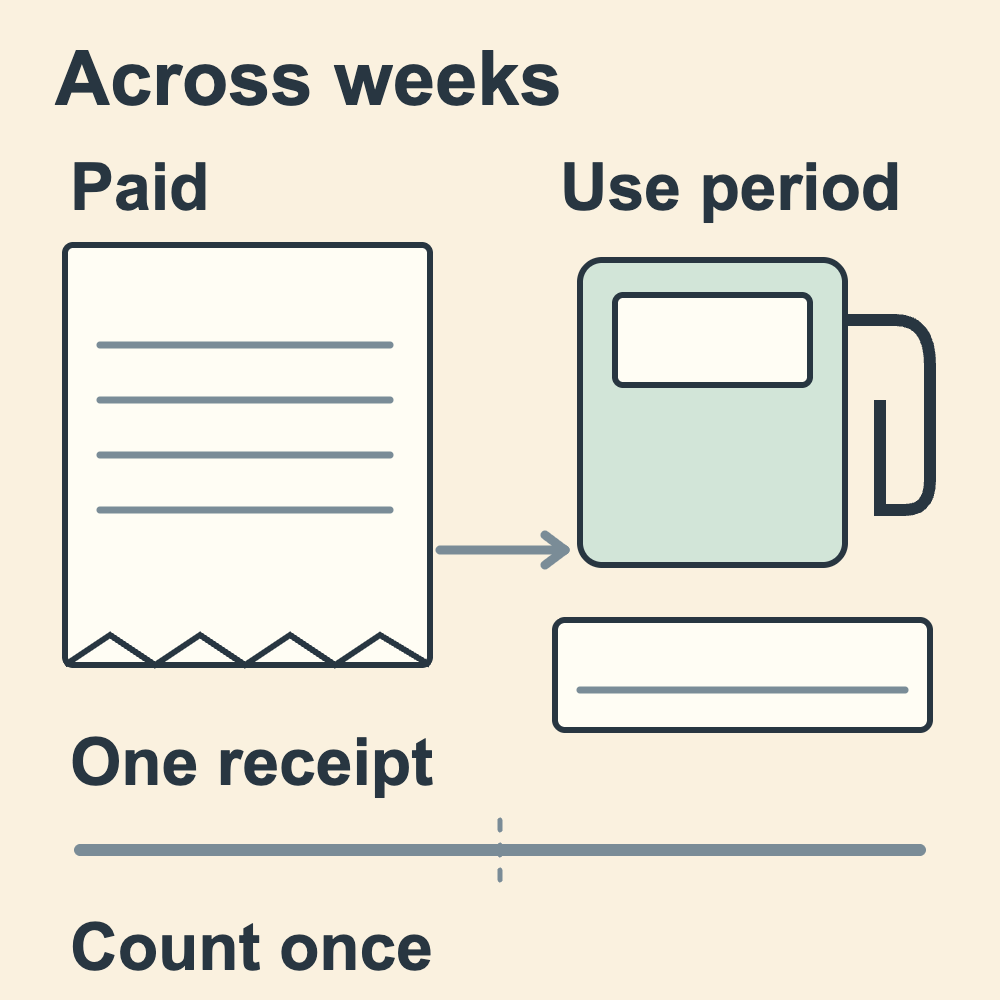
Give the same receipt two references. Put the payment in the payment record on the actual payment date, with fuel type, litres, amount paid and odometer reading. The usage interval asks which distance relates to that fuel. Payment does not mean all the fuel was consumed that day, and a new week does not reset the tank to empty. Both references can point to the same receipt; do not add its amount a second time.
A receipt alone confirms how much was paid and bought, not how much was consumed that day. Without comparable starting and ending fuel levels or other sufficient data, mark the usage interval as not yet attributable. Do not divide the payment by that day's completed deliveries and call it a verified fuel cost per order. Start with the departure and finish mileage and fuel records: that article deals with preparation before leaving, while this one connects receipts and usage across dates.
Work through a receipt in this order:
- Give the original receipt your own reference number and copy its payment date, litres, fuel type and actual amount. Keep the original; do not substitute someone else's price or vehicle consumption.
- Link the distance interval you can confirm to that reference. Record start and end odometer readings and dates, noting any week boundary or personal travel. Keep incomplete sections unconfirmed rather than assigning them entirely to deliveries.
- Only then decide whether the record supports cash expenditure or a conditional fuel-use estimate. If the payment is already included in a total, do not deduct it again under another name.
Even when using comparable refuelling states before and after an interval, record whether they were measured in the same way. Without that condition, litres added at the second fill cannot be treated as exact consumption. If an interval has sufficient usable data, let Q be fuel consumed in litres and D total distance in kilometres. Estimated use per kilometre is Q ÷ D litres per kilometre, with D greater than zero. This estimates that interval; it is neither the manufacturer's fuel-economy figure nor a guarantee for the next route.
To allocate d kilometres to delivery work, d must be between zero and total distance D. Do not estimate from duplicated, backwards or inconsistent fuel or distance records. With enough information, label Q × d ÷ D as a distance-based fuel-use allocation estimate, in litres. It assumes use can be allocated by distance; different waiting, loads and trip conditions mean this is not actual fuel for each order. If personal and delivery distance cannot be separated, omit this step for now. This article chooses no tax allocation method, declares no deductible item and provides no fixed price per kilometre.
A cross-week note can expose the missing information: “Receipt ____ is already recorded as a payment on ____. Its usage interval is currently ____ to ____, with ____ data missing. This week I therefore record only cash expenditure / separately note fuel that cannot yet be attributed.” This is a template to fill, not completed personal accounts. Keeping a gap is more traceable than forcing apparently complete figures onto one day.
This article does not redo platform selection, pay protection or hourly earnings rankings. Fuel prices, insurance and current platform conditions have not been fully checked here. Use the news category to check the original period of dated cost announcements; an old “no adjustment” headline does not mean today's fuel cost per order is unchanged.